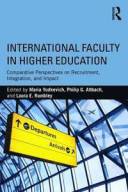
 International faculty in two top tier Chinese universities: One country and two types of internationals
The People’s Republic of China (PRC) is a country with two systems: Mainland and special administrative systems. Most universities are located in the Mainland where there has been a rapid expansion of universities, generous funding by government, and an increased in top tier international universities. Though much smaller, the Hong Kong system, known as the Hong Kong Special Administrative Region of the PRC, has more top ranked universities than any city in the world. Therefore, this chapter selects two major research universities, one in each system, for study and comparison. Both systems espouse the importance of internationalization. The Hong Kong university system, where English dominates as the medium of teaching and research, has a significant number of foreign academics, with most Chinese academics (by both citizenship and ethnicity) having earned their doctorates at overseas institutions. The mainland system leads the world in sending its scholars overseas to earn their doctorates, has witnessed a substantial increase in returnees.
This chapter focuses on two case universities—Shanghai Jiao Tong University and the University of Hong Kong (HKU)—one in each system of the PRC (the Chinese mainland and the Hong Kong Special Administrative Region), though these two are quite similar in many respects. Both are situated in world cities (Shanghai and Hong Kong), that are nodes of the global economic system. Most of their students are Chinese—nearly 95 percent at SJTU and 90 percent at HKU. Both universities are among the oldest within their respective systems: SJTU traces its roots to 1896, though its current name dates to 1938, and HKU, established in 1911, is Hong Kong’s earliest university. Both are among the world’s top 100 universities (QS 2015). Both make internationalization a priority. However, these two universities differ in academic culture and governance (Altbach & Postiglione 2012). Although both recruit internationally, virtually all of SJTU’s academic staff are Chinese nationals, while more than half of HKU’s academic staff are foreign nationals. This has much to do with the medium of instruction being English at HKU. SJTU has about 500 academic staff with overseas doctorates (25 percent of the total), and this figure has been increasing, while most all of HKU’s academic staff have an overseas doctorate. There are two points at the outset: First, most “internationalized” faculty in the Chinese mainland are Chinese nationals who earned their doctorate overseas, but some became foreign nationals and have returned to China. Second, most Hong Kong faculty earned their doctorates overseas and a very large proportion are foreign nationals by birth, but an increasing number were born in Hong Kong or the Chinese mainland. Third, there are both administrative and cultural dimensions to the integration of international faculty, especially non-ethnic Chinese speakers, in the China’s two systems.
How to cite:
 主要英语留学生接收国硕士学位学制标准比较研究
本研究采用目的抽样,以网络调查为主要研究方法,对主要留学生接收国(美国、英国、澳大利亚与加拿大)接收留学生最多的24所高校的325个硕士学位项目在入学条件、修业年限、课程安排以及学位要求方面的基本特点进行了调查。在此基础上,对四国被调查各校硕士学位学制进行了比较分析,总结了其在硕士学位学制方面的一般趋势,进而提出了优化我国硕士阶段学制标准、提升我国高等教育国际竞争力的建议。
引用格式:
谢爱磊, 欧阳玉湘. 主要英语留学生接收国硕士学位学制标准比较研究[J]. 清华大学教育研究, 2014, 35(1):94-101.
 权力下放等于重心下移吗?——一个基于香港大学管治结构变革的案例研究
本研究以香港大学的管治结构变革为案例,分析了在全球性的市场化背景下,香港大学如何通过权力的重新配置与组织上的改进来实现治理与管理方面的双重变革.通过案例分析,我们发现尽管高校内部权力在不同主体间的重新配置需要权力组织形式的变革,但是教师、学生等基层主体权力的强化却并不一定导致在进行组织的设计时权力从上层机构向下层机构的下放.
引用格式:
谢爱磊. 权力下放等于重心下移吗?——一个基于香港大学管治结构变革的案例研究[J]. 复旦教育论坛, 2013, 11(6):29-33.
 高等教育国际化中的“ 新跨国主义”
近来, 有关高等教育国际化问题的研究越来越多, 一系列新的语词与概念不断涌现, “ 新跨国主义” 就是其中之一。“ 新跨国主义”向我们揭示了高等教育国际化一种新的取向: 它以经济全球化, 信息科技的发展, 以及教育服务贸易自由化为背景, 以学习项目和学校的跨国流动为特点, 以高等教育机构的跨国运作、合作和远程跨国教学为主要形式。本文力图对“ 新跨国主义”做一点介绍, 并指明其可能带来的机遇与挑战。
引用格式:
谢爱磊, 唐安国. 高等教育国际化中的“新跨国主义”[J]. 中国教育政策评论, 2006, 35(7):60-64.
 xieailei.me